
- Published on
Anomaly Detection and Faults Prediction in Printer Machines Using LSTM Autoencoder and Extra Trees Classifier
Essay on a new approach
- Authors
 Shaimaa Atraoui
Abstract
Predictive maintenance is a key concept in Industry 4.0, utilizing data analytics and machine learning to forecast equipment failures and perform predictive maintenance. This approach aims to enhance machinery reliability and longevity while reducing costs and boosting efficiency. Traditional fault classification methods depend on expert knowledge and established patterns, which may not adapt well to complex fault scenarios. Standalone anomaly detection methods offer a data-driven approach but may lack fault differentiation. This study proposes a novel strategy combining early fault prediction with anomaly detection for a more precise predictive maintenance solution. The paper explores the processing of both approaches and includes a real-world case study to demonstrate the proposed method's effectiveness.
I. Introduction
Predictive maintenance is crucial for ensuring machinery reliability and longevity, reducing maintenance costs, and increasing operational efficiency by identifying and addressing faults before significant downtime occurs. However, accurate fault prediction and anomaly detection remain challenging.
Traditional fault classification methods focus on recognizing specific fault types using established patterns, which often require expert knowledge and may struggle with complex, evolving fault patterns. Anomaly detection methods, while data-driven and effective at spotting deviations from normal behavior, may not differentiate between fault types effectively.
This study proposes integrating early fault prediction with anomaly detection to enhance predictive maintenance. This integration aims to offer a more comprehensive and accurate solution by combining the strengths of both approaches. The paper discusses the processing of these approaches and demonstrates the proposed method's effectiveness through a real-world case study.
II. Predictive Maintenance - State of the Art
A. Different Approaches to Predictive Maintenance
Predictive maintenance includes various practical applications, such as Fault Detection and Diagnosis (FDD) and Anomaly Detection algorithms. FDD uses intelligent algorithms to analyze sensor data and diagnose potential faults, enabling proactive corrective measures. Anomaly Detection excels at identifying subtle abnormal behavior in equipment.
Remaining Useful Life (RUL) assessment is another approach, indicating the time left until an asset's expected operational life ends. Creating a generic model for RUL estimation can be challenging due to varying degradation levels and operating conditions.
Challenges in predictive maintenance include improving estimation accuracy and addressing the complexity of statistical methods. State-of-the-art algorithms, such as linear regression models, Hidden Markov Models, and Long Short-Term Memory Neural Networks, require extensive modeling and training but have limitations.
Kusumaningrum et al. (2021) proposed a fault diagnostic algorithm using multi-class classification and RUL prognostics. Predictive maintenance data with a temporal dimension requires feature engineering to process time series datasets and extract valuable features. Techniques like the Pearson correlation test can help select relevant features.
Deep Learning algorithms, such as autoencoders with LSTM layers, offer a solution by processing time-series data for predictive maintenance. However, challenges remain in integrating physical assets, extracting valuable data, and developing accurate predictive algorithms.
B. Approach for Early Fault Prediction
Early fault prediction involves analyzing historical sensor data to identify patterns or indicators of potential faults. By predicting faults in advance, maintenance teams can take proactive measures to reduce downtime and prevent failures.
In this approach, I label data recorded before a 24-hour interval of a known fault occurrence with the same fault label. The Extra Trees classifier is then used to predict fault classes, allowing anticipation of faults before their occurrence.
III. Integration of Anomaly Detection and Fault Prediction for Predictive Maintenance
A. Objective
To create a comprehensive predictive maintenance framework, I propose integrating anomaly detection using LSTM-based autoencoders with predictions from the Extra Trees classifier. This integration combines the strengths of both techniques to enhance early fault prediction.
Let:
- be the multivariate time series dataset with instances.
- be the corresponding fault labels indicating fault presence within a 24-hour frame.
- is the time frame (24 hours) for predicting fault occurrence.
The objective is to build a predictive model that forecasts fault occurrence within the next time frame based on the current state of the dataset.
B. Incorporating Anomaly Detection Results
The LSTM-based autoencoder consists of an encoder and a decoder to capture temporal dependencies and reconstruct input sequences. The reconstruction loss, measured as MSE or RMSE, indicates anomalous behavior. Instances with high reconstruction loss are considered anomalies.
The reconstruction loss is calculated as:
Where is the number of features, and are the original and reconstructed values, respectively. An anomaly is flagged if .
C. Using Extra Trees Classifier for Fault Prediction
With the enriched dataset (including reconstruction loss), I train the Extra Trees classifier for fault prediction. This enables early fault prediction and the detection of new or potential faults.
VI. Case Studies and Practical Applications
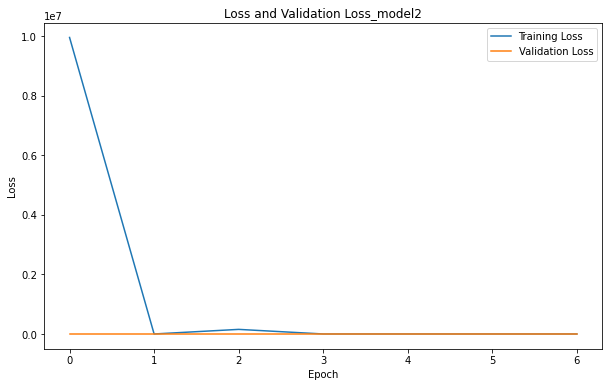
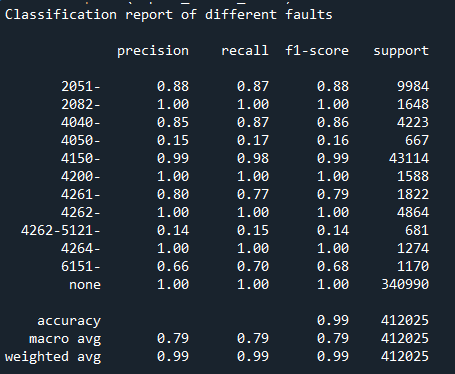
Case Study 1: Machines Banch 1 Dataset
Case Study 2: Machines Banch 2 Dataset
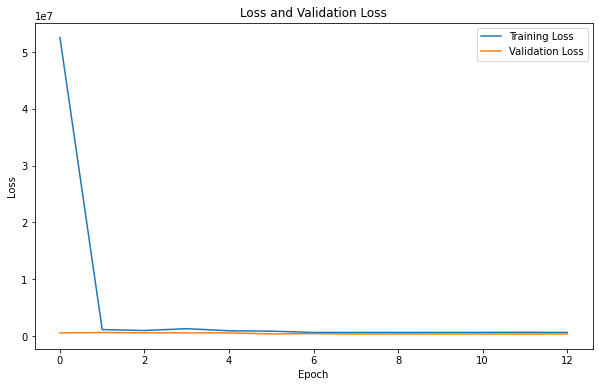
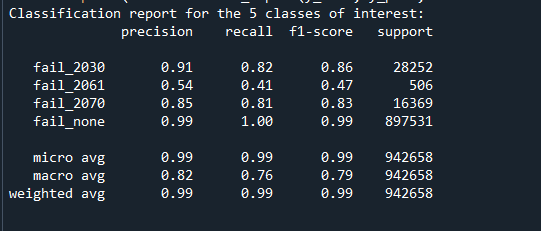
Data collected every 10 minutes showed the integrated approach's effectiveness in predicting faults 24 hours in advance.
D. Advantages and Limits
Advantages:
- Complete Fault Detection: Captures both known and unknown fault types.
- Enhanced Accuracy: Combines anomaly detection and fault prediction strengths.
- Adaptability: Updates models with new data to remain effective.
Limits:
- Model Complexity: Integration increases model complexity.
- Data Requirements: Requires extensive data for training and validation.
VII. Conclusion and Perspectives
The integrated approach of using LSTM-based autoencoders and Extra Trees classifiers offers a powerful solution for early fault prediction in predictive maintenance. This method enhances maintenance operations, reduces downtime, and improves system reliability. As industries adopt predictive maintenance, this framework provides a promising way to optimize strategies and reduce costs.
